
5 Ways Security Compliance Supports Facility Clearance Success
Key Takeaways
- Effective security compliance assists organizations in minimizing clearance risks and being ready for audits.
- A compliance-first culture builds accountability and protects sensitive government information.
- Regular training, documentation, and risk assessments strengthen facility clearance stability.
- Smarter security compliance practices help businesses align with NISPOM and DCSA requirements.
- Consistent compliance efforts increase government trust and support long-term clearance success.
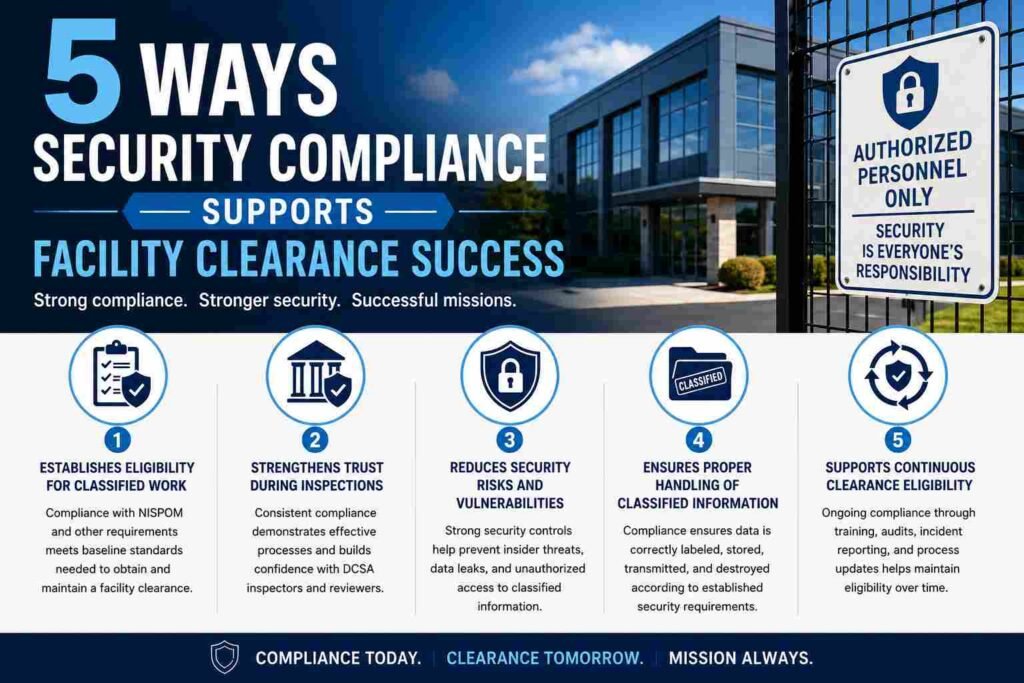
What does it really take to earn and maintain a successful facility clearance in today’s high-risk defense environment? The solution begins with Security Compliance that will help to safeguard classified information, minimize vulnerabilities, and gain trust from the government. Given the increasing trends of cyberattacks and pressure from regulation, the matter cannot be addressed in a negligent way anymore.
According to the latest GAO report, the DCSA has observed over 815 security findings and over 1,000 vulnerabilities in cleared contractors for FY2025. As defense regulatory standards such as CMMC keep on growing within the industry, companies that focus on compliance stand a greater chance of success in terms of growth, eligibility for contracts, and safety.
Compliance solutions are increasingly in demand since companies are keen on obtaining and maintaining their facility clearances. This blog will help you understand 5 Ways Security Compliance Supports Facility Clearance Success.
5 Ways Security Compliance Strengthens Cleared Facility Integrity
Facility clearance can be said to be more than just the paperwork involved. The process hinges on the ability of an organization to safeguard sensitive data, comply with federal laws, and maintain operational consistency. This is when security compliance becomes extremely important in building a credible atmosphere for cleared facilities.
As governmental authorities become more strict with regard to control, businesses need to demonstrate their ability to deal with classified information appropriately. Compliance with proper security measures will not only help minimize possible threats but also ensure long-term clearance. The organizations that show interest in compliance tend to be more ready for audits.
1. Turning Security Compliance Into a Clearance Advantage
Companies that consider security compliance as one of their major priorities can develop a competitive advantage by undergoing the facility clearance procedure. Proper policies, good systems, and good processes show reliability to government bodies. This proactive approach helps reduce delays, improve operational confidence, and strengthen overall clearance readiness.
2. Building a Facility Clearance Framework That Inspires Trust
A proper clearance process starts by ensuring consistency and accountability. As long as the organization is able to maintain sufficient documentation and compliance with the NISPOM requirements, as well as carry out regular security audits, then the organization becomes consistent in managing classified information. Compliance also helps one to be confident that security takes precedence.
3. Creating a Compliance-First Culture for Cleared Facilities
Successfully cleared facilities understand that compliance is not limited to leadership teams alone. The protection of sensitive data is greatly attributed to employees because they are trained to be aware and handle information securely. Compliance culture ensures that everyone is accountable while enabling organizations to minimize their risks internally.
4. Transforming Security Compliance Into Long-Term Clearance Stability
The maintenance of a facility clearance is a process that needs to be ongoing and requires continuous improvement as well. Such organizations that will ensure that they update themselves on their own policies and vulnerability management will be in a position to cope with regulatory changes.
5. Strengthening Government Confidence Through Smarter Compliance
Companies that maintain good records of having followed security policies and been transparent during audits and inspection exercises become favorites among government authorities. In essence, companies should be wiser in matters concerning compliance processes by conducting risk assessment and internal controls. Credibility can be established in time.
How Dive Deep Security Makes Facility Clearance Less Complicated
It is very easy for facility clearance needs to overwhelm an organization if it does not have the proper expertise and knowledge on how to navigate the process effectively. With Dive Deep Security, clients benefit from enhanced security posture with help in complying with regulations, outsourcing of FSO responsibilities, and risk mitigation strategies.
Key Features of Dive Deep Security
- Expert outsourced Facility Security Officer (FSO) support.
- Guidance for Facility Clearance (FCL) preparation and management.
- Ongoing Security Compliance monitoring and audit readiness.
- NISPOM and DCSA compliance support.
- Personnel clearance and documentation management.
- Insider threat program development and implementation.
- Customized security training and policy development.
- Risk mitigation strategies for cleared facilities.
- Support for DISS, NISS, NBIS, and other government systems.
- Tailored compliance solutions for defense contractors and secure operations.
Conclusion
Facility clearance is not all about meeting bare-minimum standards. Ensuring security compliance results in a stronger and more secure basis to safeguard classified information and minimize risks in operations.
The continued evolution of regulations means that organizations with effective strategies for compliance will be able to enjoy continuous stability in clearance. For help to achieve maximum compliance and enhance clearance processes, get in touch with Dive Deep Security today.
Frequently Asked Questions
The security compliance process helps organizations to satisfy regulatory requirements, maintain classified information security, and ensure facility clearance authorization.
Security compliance limits risks by ensuring enhanced cybersecurity protection and risk management processes.
Security training ensures employees’ awareness of security compliance obligations and avoids security violations.