
The Role of Facility Security Officers in AI-Era National Security
Key Takeaways
- Facility security officers’ roles in the AI era go beyond just following rules – they need to predict new dangers too.
- AI assists FSOs in quickly detecting odd behavior, yet human judgment stays crucial.
- Constant training is key to making FSOs stronger in tech-driven environments.
- The top security plans mix advanced tech with seasoned pros; that’s what works best.
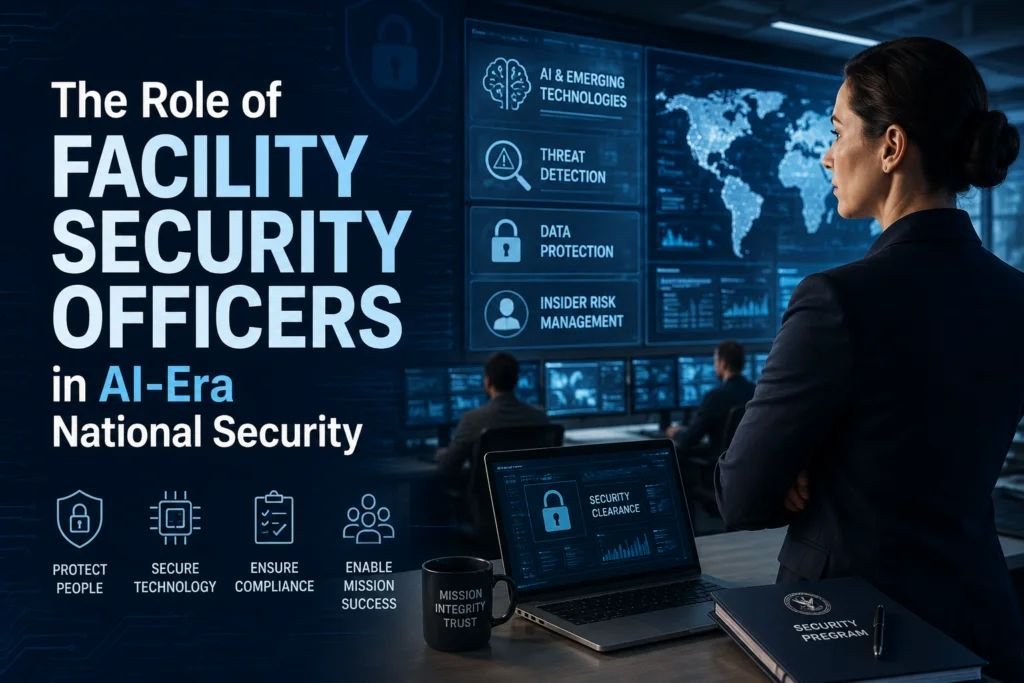
What happens when a facility’s security officer faces an enemy that learns faster than any human? The answer is not to replace the officer but to give them smarter tools. The Role of Facility Security Officers in AI-Era National Security is changing fast. They are no longer just checklist followers. They are becoming defenders who use artificial intelligence to stay one step ahead of modern threats.
The U.S. Government Accountability Office reports security breaches targeting defense firms will soar to over 40% using AI techniques such as deepfakes and auto-hacking by 2028. This marks a huge leap from under 5% in 2023. Because of this, there’s a serious need for trained security officers in defense companies each day.
More companies are looking for officers who understand both basic security rules and AI dangers. But there are not enough such officers yet. This blog will help readers understand the role of facility security officers in AI-era national security. And Deep Dive Security helps organizations by offering expert FSO support, smart security advice, and easy-to-follow plans for the AI age.
Role of Facility Security Officers in AI-Era Threats
AI’s changing security in both wartime and peacetime too. It strengthens defenses for groups, yet attackers make use of it to cook up sneaky, tough-to-detect schemes. So while we get safeguards, the bad guys get smarts too.
Today’s facility security officers deal with challenges that didn’t exist just a few years back. Now, deepfakes can mimic trusted personnel, and AI creates phishing emails that seem totally real. Plus, automated tools now rapidly hunt for security flaws more efficiently than old-school hackers. On top of that, there’s been a spike in AI-driven scams and deepfake schemes aimed at organizations globally, according to security pros.
Traditional security checklists usually concentrate on known risks and set procedures. However, AI-driven threats constantly change and grow. So what worked before might not protect you now. Thus, old solutions become ineffective quickly.
This shift makes facility security officers more important in the AI era. They aren’t just about following rules; FSOs are now frontline defenders dealing with rapid changes in both digital and physical security threats.
How AI Reshapes Daily Security Operations
AI’s help allows security teams to prevent incidents rather than just react to them.
Now, with modern security systems, tons of data get analyzed, detecting suspicious patterns people might miss. For example:
- Unusual badge access activity
- Suspicious login behavior
- Abnormal employee movement patterns
- Potential insider threat indicators
Instead of spending hours reviewing reports manually, FSOs can use AI-driven insights to focus on higher-priority risks.
AI is also simplifying routine administrative tasks such as:
- Visitor management
- Access authorization reviews
- Security documentation tracking
- Compliance monitoring
Tech is key, but security pros need to read AI warnings right, spot false positives, and figure out when gut feelings are better than machine judgments. The real winners? Those who nail blending tech with experience and sharp thinking.
Protecting National Assets Against AI-Powered Adversaries
As attackers get smarter, protecting places with sensitive info requires multiple layers of defense.
AI can spot insider threats by picking up on unusual behaviors early on too. At the same time, foes use AI to amp up their game, automating phishing, making convincing fakes, and pulling off large-scale targeted social engineering attacks.
The strongest security programs combine:
- AI-powered monitoring
- Continuous personnel evaluation
- Multi-factor authentication
- Security awareness training
- Human-led investigations
It’s not about replacing people with technology in the AI era for security. Instead, we use AI to boost what facility security officers can do while making sure humans are still in charge of big decisions.
Groups that find a good balance between automation and human judgment are way better at protecting national assets from new risks.
Future-Proofing the FSO Role with Deep Dive Security
AI advancements are speeding up, so security teams need to keep evolving too.
Deep Dive Security helps financial services organizations by providing expert training, AI-readiness checks, and intel on new threats. They also give valuable tips on future risks, keeping clients super safe. These resources help security professionals understand new attack methods while building stronger response strategies.
Key focus areas include:
- AI threat awareness training
- Deepfake detection education
- Insider threat management
- Security program modernization
- Continuous evaluation practices
By investing in ongoing education and proactive security planning, FSOs can remain ahead of evolving threats rather than reacting to them after the fact.
Conclusion
The role of facility security officers in the AI era won’t get replaced, but their roles will change. With threats getting smarter, the winners will be those using advanced tech alongside skilled staff. FSOs can enhance protection and cope with future challenges by adopting new tools and partnering with companies like Deep Dive Security. This lets them keep vital assets safe and stay resilient.
Frequently Asked Questions
Because AI-powered threats are getting more advanced, FSOs need to get smarter too, adopting more proactive security methods.
It can spot unusual behavior, take care of mundane tasks, and alert folks about possible dangers early on.
They ought to grasp AI-driven security tools and learn how to detect threats and assess risks properly. Evaluating AI-generated warnings accurately is key too.