
What Does Facility Clearance Mean for Government Contractors?
Key Takeaways
- An FCL allows eligible contractors to access classified information.
- Contractors need sponsorship before beginning the FCL process.
- Accurate documentation can help avoid unnecessary delays.
- Security responsibilities continue after clearance is granted.
- Professional FSO support can help manage ongoing requirements.
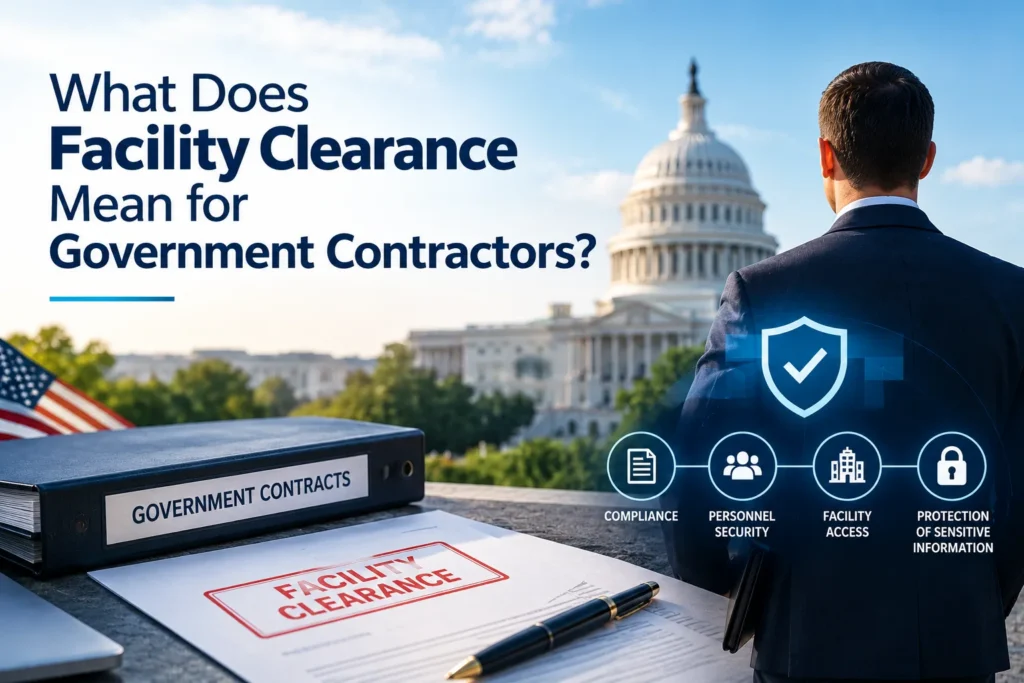
What does a contractor need before it can work with classified information on a government contract? In many cases, the answer is a facility clearance, or FCL. DCSA describes an FCL as a determination that an organization is eligible to access classified information when there is a legitimate government requirement. Contractors cannot sponsor themselves. The process begins when a government contracting activity or another cleared contractor provides sponsorship through NISS.
However, being cleared is just the first step. Contracting firms must adhere to security requirements, manage cleared personnel, maintain the accuracy of the paperwork, and be prepared for any DCSA inspections. It is particularly important to keep in mind the fact that, according to DCSA, inaccuracies in sponsorship packages might result in their rejection.
What Is a Facility Clearance?
A Facility Clearance (FCL) is an administrative determination that allows an eligible organization to access classified information at an approved level for an authorized requirement.
DCSA processes, issues, and monitors FCL eligibility under the National Industrial Security Program. A facility awarded a classified contract as a prime or subcontractor must have an active FCL at the required level to perform classified work.
An FCL is therefore not simply a certificate a company receives and forgets about. It places the organization within an ongoing security framework.
When Does a Contractor Need an FCL?
Not every government contractor needs an FCL. The requirement depends on whether the work involves access to classified information.
A contractor may need one when:
- A classified contract requires facility-level access.
- Employees need classified information to perform their duties.
- A subcontractor must access classified information from a cleared prime.
- Classified information needs to be safeguarded at the facility.
DCSA requires a legitimate need for classified access before an organization can be sponsored.
How Does the FCL Process Begin?
The process starts with sponsorship. A Government Contracting Activity or another cleared contractor submits the sponsorship request through the National Industrial Security System (NISS). DCSA will then assess the application and either accept it, reject it, or ask for further information.
Accuracy is extremely important at this point. DCSA identifies incomplete or inconsistent information as a common reason for sponsorship problems. A contractor should therefore have its business information and supporting documentation organized before submission.
Key Preparation Areas
- Company and ownership information
- CAGE Code
- Key Management Personnel details
- DD Form 254 and supporting documents
- Required security agreements
- Foreign ownership considerations
- FSO and security program responsibilities
What Happens After Clearance?
An FCL does not eliminate the contractor’s security responsibilities. Once a facility is cleared, DCSA retains oversight authority and works with facility management and the FSO to support the protection of classified information.
That means contractors need to maintain their security program as their operations change. New employees, contract modifications, organizational changes, and evolving requirements can all affect how security responsibilities are managed.
DCSA states that an FCL remains valid while there is an active classified contract and a continuing need to access classified information for that contract.
Why Personnel Security Still Matters
An FCL applies to the organization, while individual employees may require personnel security clearances before receiving access to classified information.
This creates another layer of responsibility for contractors. Clearance-related activities, personnel records, access decisions, and required security training need to remain organized as the workforce changes.
With an expanding contracting company, taking care of such minutiae on one’s own becomes quite a task indeed. Experienced security management assistance could offer more organization to ensure that some duties are not forgotten.
Common Challenges in the FCL Process
Incomplete Documentation
Incomplete data or inconsistencies could cause delays. DCSA notes that incomplete and inaccurate sponsorship packages can be rejected.
Unclear Business Information
DCSA reviews business governance information and determines which Key Management Personnel may need clearance based on their roles, responsibilities, and authority.
Foreign Ownership Concerns
Foreign Ownership, Control, or Influence (FOCI) is another consideration. DCSA evaluates FOCI as part of the facility clearance process, and applicable concerns must be resolved before eligibility can be established.
Preparing Too Late
Security responsibilities should not be considered only after the FCL has been approved. Establishing clear procedures and assigning security responsibilities early can make ongoing compliance easier.
How FSO Support Services Can Help
The FCL process involves more than completing forms. Contractors also need to manage personnel security, documentation, training, policies, and continuing compliance.
Professional FSO support services can provide expertise across these areas. Depending on the organization’s needs, support may include FCL management, security program development, personnel clearance assistance, DCSA preparation, self-inspections, and security training.
Dive Deep Security works with contractors that need experienced assistance managing these responsibilities and building a practical security program.
Why Facility Security Officer Services Matter
Once classified work becomes part of a contractor’s operations, security needs regular attention. Someone must coordinate requirements, maintain records, support cleared employees, and help the organization stay prepared for oversight.
Professional facility security officer services can give contractors access to experienced security professionals without requiring them to establish a large internal security department.
This can be especially useful for smaller businesses, newly cleared contractors, or organizations whose classified workload changes over time.
When Are Outsourced FSO Services Useful?
Not every contractor has the same staffing requirements. Some organizations may have an internal FSO, while others may need additional expertise or temporary coverage.
Outsourced FSO services can provide flexible assistance when a contractor:
- Is pursuing its first FCL.
- Has limited internal security experience.
- Is preparing for DCSA oversight.
- Has a growing, cleared workforce.
- Needs interim security coverage.
- Requires supplemental expertise.
Dive Deep Security provides interim, long-term, supplemental, and fully outsourced FSO support based on contractor requirements.
How Dive Deep Security Helps
Dive Deep Security supports government contractors with FCL and personnel clearance management, security program development, DCSA review preparation, training, documentation, and ongoing security responsibilities.
Its team can provide practical support at different stages of the clearance lifecycle, helping contractors manage security requirements without allowing them to overwhelm their core operations.
Conclusion
A facility clearance provides clearance for qualified contractors to perform classified work, but there are also some security obligations attached to this clearance. Each of the stages in the process needs proper handling.
Establishing the right security structure early can make those responsibilities easier to handle. With experienced support, contractors can maintain a more organized security program while staying focused on their government work.
Frequently Asked Questions
No. An FCL is generally required when an organization has a legitimate need to access classified information for a government requirement.
No. DCSA requires sponsorship from a Government Contracting Activity or another cleared contractor.
DCSA states that an FCL remains valid while there is an active classified contract and a continuing need to access classified information.
Yes. External FSO support can give smaller or growing contractors access to experienced security professionals without requiring a large internal security team.