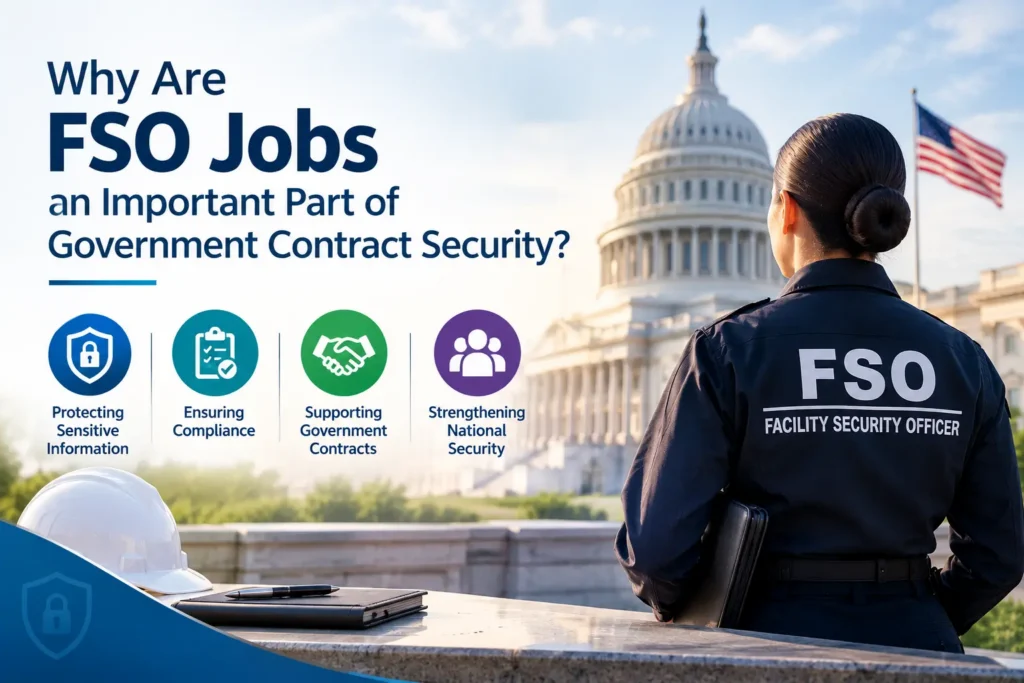
Why Are FSO Jobs an Important Part of Government Contract Security?
Key Takeaways
- FSOs oversee critical elements of a contractor’s industrial security program.
- Their responsibilities include training, records, security controls, and self-inspections.
- Strong FSO oversight helps contractors remain prepared for DCSA reviews.
- Outsourced support can help organizations manage security without expanding internal teams.
Security for government contracts with classified information involves much more than just securing a government contract. Somebody needs to ensure that security policies are adhered to, that the employees are aware of their security responsibilities, that the clearance files are up-to-date, and that the firm is ready for government inspections. It is here that FSO jobs are critical in security.
The Defense Counterintelligence and Security Agency (DCSA) assigns Facility Security Officers extensive responsibilities under the National Industrial Security Program, such as overseeing the security policies, personnel security file maintenance, mandatory training for employees, and conducting self-inspections at least once per year. For the contractor, having competent security professionals in these positions would be very helpful in protecting classified information and organizing routine compliance activities.
What Does an FSO Do for a Government Contractor?
A Facility Security Officer serves as a central point for managing a contractor’s industrial security program. The role connects management, cleared employees, government requirements, and the organization’s internal security procedures.
The FSO does not simply maintain paperwork. The position involves active oversight of how classified information is protected and how security responsibilities are implemented throughout the facility.
Managing Classified Information
One of the important tasks is making sure that any classified data is well protected and that it is only available to those who have clearance for it.
The facility security officer services help turn those requirements into practical workplace processes. Whereas there is a clear and uniform security procedure, the staff members will have an enhanced knowledge of what is required of them.
Supporting Personnel Security
Personnel security is another major part of the role. FSOs help maintain security eligibility and access records and support clearance-related activities for employees who require access to classified information.
This becomes particularly important as a contractor grows. New hires, changing responsibilities, and evolving contract requirements can create additional clearance-related work that needs careful coordination.
Why Are FSO Jobs Valuable to Contractors?
Sometimes security requirements may be hard to handle, as they will be given to individuals who are already occupied with other activities. There will always be clarity on ownership and continuous focus by security experts.
Their work can help contractors:
- Maintain security documentation.
- Support clearance administration.
- Coordinate required training.
- Prepare for DCSA reviews.
- Conduct required self-inspections.
- Address security weaknesses.
- Maintain communication with government security personnel.
The value is not simply administrative. A capable FSO helps create a security program that operates as part of the organization’s normal workflow.
Keeping Employees Security-Aware
Security depends heavily on employee behavior. Even well-written procedures cannot protect classified information if employees do not understand how those procedures apply to their work.
FSOs are responsible for ensuring required security briefings are provided, including initial, refresher, debriefing, and special briefings when applicable.
Communication will also make it easier for employees to bring up their issues at an earlier stage, thus providing more time for the organization to solve any problems that could arise.
Staying Prepared for DCSA Oversight
A contractor should not begin preparing for a DCSA review only after receiving notice of one. Security readiness is an ongoing responsibility.
DCSA’s review process examines areas such as NISPOM compliance, security controls, management support, security awareness, and the effectiveness of the facility’s security program.
An FSO can help maintain readiness by keeping records current, monitoring corrective actions, reviewing procedures, and making sure required activities are completed throughout the year.
What If a Contractor Does Not Have an Internal FSO?
Not every contractor has the resources or workload to maintain a large internal security team. Smaller businesses, newly cleared organizations, and companies experiencing rapid growth may need additional expertise.
This is where FSO support services can provide a practical alternative. Contractors can obtain experienced assistance with security program administration, clearance management, training, DCSA preparation, and documentation without necessarily creating a larger permanent department.
Dive Deep Security provides both supplemental and fully outsourced FSO support, including interim and long-term staffing options.
The Role of an FSO Company
Working with an experienced FSO company can give contractors access to professionals who understand the operational side of industrial security. Instead of approaching every requirement independently, organizations can have knowledgeable support available to help coordinate the different parts of their security program.
Dive Deep Security, for example, provides outsourced FSO solutions covering facility and personnel clearance management, DCSA review preparation, security training, policy documentation, Insider Threat Program support, and administration of systems including DISS, NISS, NBIS, eApp, and ACCS.
How Dive Deep Security Supports Contractors
Dive Deep Security works with government contractors that need practical security expertise without unnecessary internal overhead. Its team provides outsourced and supplemental support tailored to a facility’s security requirements.
The firm can assist contractors at various levels of their security journey, from sponsoring FCLs to developing security programs and conducting compliance activities to DCSA reviews. The services of the firm are geared towards helping the organizations keep their security responsibilities without distracting their teams from their mission.
Conclusion
FSO responsibilities are closely tied to the success of a contractor’s overall security program. From clearance management and employee training to classified information protection and DCSA readiness, the role requires knowledge, consistency, and attention to detail.
For organizations with limited internal resources, professional support can provide the additional capacity needed to keep security operations moving. Whether a contractor needs an internal professional, supplemental expertise, or outsourced assistance, choosing the right security structure can make compliance easier to manage.
Frequently Asked Questions
The FSO controls the security requirements imposed by the NISPOM, manages security records, provides for training as necessary, and conducts the annual formal inspection of the facility.
Not at all. Contractors who differ in size may require the help of an FSO where classified information is concerned. For small contractors, it would be prudent to consider outsourcing for their security needs.
Yes. Dive Deep Security provides outsourced FSO support as well as supplemental expertise for government contractors that need assistance managing their security programs.