
How FSO Services Prevent NISPOM Compliance Errors
Understanding the Stakes of NISPOM Compliance
Contractors working with classified materials have strict regulations while working within a prescribed structure that identifies consequences for minor errors. The NISPOM establishes standards that all contractors must follow for protecting sensitive Government information with clearly defined guidance; unfortunately, contractors face complications interpreting those requirements and applying them consistently, particularly when contractors are new to Federal contracting or are growing. Contractors commonly experience compliance mistakes, not because of negligence, but for a number of reasons, including a lack of knowledge of the requirements, using obsolete compliance processes, or a lack of qualified compliance personnel. It is in these circumstances that FSO services become both beneficial and critical for all contractors. A professional FSO works as both a mentor and a protector to assist contractors in the proper interpretation of security requirements and to help ensure the security requirements are properly and consistently complied with daily in their contractor operations. A contractor that handles compliance issues reactively will typically experience compliance issues showing up in audits or inspections, which could affect the contractor’s credibility and could indirectly delay receiving contracts. Contractors who manage their compliance in a proactive manner via qualified FSO services have the potential to identify existing compliance issues early and to maintain compliance readiness on a continuous basis.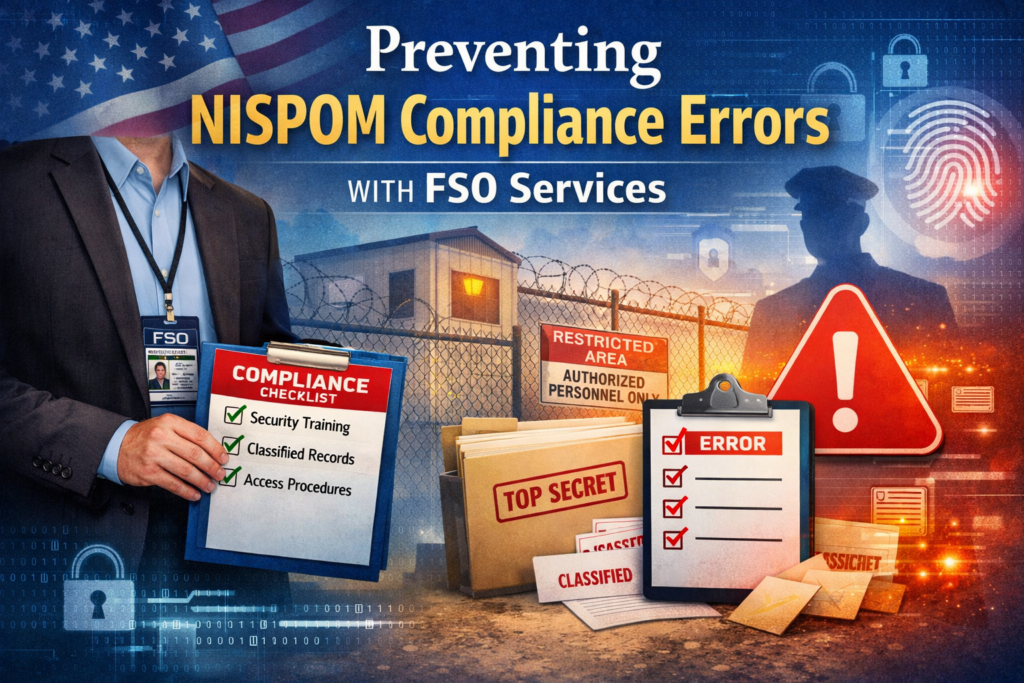
Common Compliance Pitfalls and Why They Happen
Compliance problems also exist among entire agencies and not just among individual agencies. Common compliance mistakes made by entire agencies are the delivery and retrieval of classified documents, the continuing emphasis on accurate records (which should be established each month), and ongoing training; however, lack of documentation will negatively impact the agency’s ability to deliver and collect records from its constituents, particularly because the agency has to meet multiple deadlines with a high volume of records, and therefore cannot adequately assess its ability to handle compliance activities.
The two primary sources of lack of compliance for both individuals and groups are poor communication internally (clients and agencies are sending and receiving the same type of materials) and/or not constituting a standard uniform method of recording new employees (only permitting certain employees to have access to sensitive materials). Without a uniform and adequate process, individuals’ rights will be violated due to inconsistent practices between what they think are legally permissible and what the agency believes is necessary to comply with legal requirements.
Communication issues can be a reason for the lack of compliance of many organizations and create significant practical, legal, or even operational barriers to meeting federal, state, or other applicable laws/regulations.
How FSO Services Help Prevent Errors
The Facility Security Officer (FSO) service provides organizations with a systematic and professional method for managing compliance. The primary benefit of using FSO services is that they can take the complex legal language found in regulations and turn it into a simple list of actions that employees can easily understand and follow to ensure they are compliant with the law. This reduces confusion and helps to make it clear to all employees what they need to do in order to comply with the law.
An experienced FSO will put into place an FSO service that clearly defines the procedures that must be followed to secure classified materials, manage personnel records, and manage and protect all systems that contain sensitive data. The procedures that are established will not be fixed for all time, but they will be updated on a regular basis to reflect changes in either the regulatory requirements or the needs of the organization, thus allowing the FSO to remain flexible to changes in the environment.
Training employees on compliance is another area where FSO services can make a significant difference. Through regular and engaging training sessions, employees will learn what is expected of them and how they will be able to effectively perform their responsibilities. Rather than viewing compliance as a burden to the organization, teams will learn that compliance is a service to the organization and that they have a shared responsibility for the organization’s success.
In addition, FSO services take a proactive approach to meet the above requirements; an organization should conduct regular internal audits to ensure all activities comply with federal regulations. Routine internal auditing will identify any deficiencies prior to them becoming an issue. In preparation for future external audits, organizations should continuously monitor regulatory compliance, thereby eliminating any concerns about the external audit.
Building a Culture of Compliance for Long-Term Success
Preventing compliance vulnerabilities means more than just following rules; it involves a culture of security and responsibility being incorporated into daily work. The FSO services are critical to establishing this culture through their development of awareness, consistency, and trust.
Another part that is equally important in building and creating a culture of compliance is consistency. If teams follow the same policies and procedures across their respective project teams, they will help reduce confusion by providing uniformity or standardization for all teams to follow, so they have clearly defined rules for the use of all resources for each project. This is accomplished by having the FSO provide guidance and oversight.
Another factor that helps create an environment where compliance is paramount is the establishment or encouragement of transparency. Providing an environment where employees feel safe to express concern and/or to ask questions concerning compliance issues can lead to earlier identification of compliance issues and quicker resolutions, thus enhancing the overall security posture for the organization.
Generally speaking, as companies make greater use of FSO service companies over time, they will find compliance is easier to manage than before, and it will be less stressful. In place of continuing to react to problems, they will now have the ability to deal with them in an effective and efficient manner. Not only does this serve to protect the confidentiality of sensitive data/information, but it also enhances their reputation within both the defense and security areas as dependable business partners.
With the high risk and complex regulatory environment in today’s world, having the right experience is critical to success. Facility Security Officer Service provides the structure and guidance needed so that errors do not occur, support continues to be provided for growth, and compliance across the organization is resilient and sustainable long-term.
Conclusion
In order to effectively manage and comply with NISPOM guidelines, it is important to have qualified professionals available for assistance. Dive Deep Security offers dependable FSO services designed to streamline regulations, minimize risks, and enhance your organization’s procedures. With the assistance of Dive Deep, organizations will be able to maintain compliance and confidence while concentrating efforts towards expansion/crop growth based on maintaining a robust and secure environment.
Frequently Asked Questions
FSOs enforce security policies, train personnel, monitor processes, and manage classified information to prevent mistakes that could violate NISPOM rules.
FSO-led training ensures employees understand proper handling, storage, and transmission of classified information, minimizing the risk of procedural errors.
Yes. FSOs maintain accurate records, monitor compliance, and implement corrective actions so organizations are prepared for audits and inspections.